Periodontal Pocket – Treatment and Therapy

TL;DR

A periodontal pocket is a space that forms between the tooth and gum due to the destruction of tissue and bone. Treatment depends on pocket depth — from non-surgical, painless cleaning for shallower pockets, to surgical therapy for deeper changes. With timely intervention by a periodontology specialist, it is possible to stop the disease and save the teeth.

Treatment depends on the depth and structure of the periodontal pocket. If oral hygiene is poor, the first step is ultrasonic removal of all soft and hard deposits, followed by precise measurement of pocket depth.

Treatment begins with causal therapy (non-surgical debridement of the periodontal pocket — deep cleaning below the gum line). If, after completing causal therapy, the pocket exceeds 5 mm in depth, surgical treatment is indicated — a flap procedure. For pockets deeper than 4 mm, thorough debridement with specialized periodontal curettes is required, along with copious irrigation, ultrasonic removal of deposits, and a mandatory follow-up after 10 days, with home care instructions provided.

At the follow-up appointment, the periodontologist reassesses tissue condition and determines whether further debridement is needed and what the next steps in therapy should be.

If the pocket depth exceeds 5 mm following completed causal therapy, surgical treatment is indicated — a modified Widman flap procedure with bone graft placement.

Periodontal pockets can be effectively treated when the patient seeks specialist care in time.

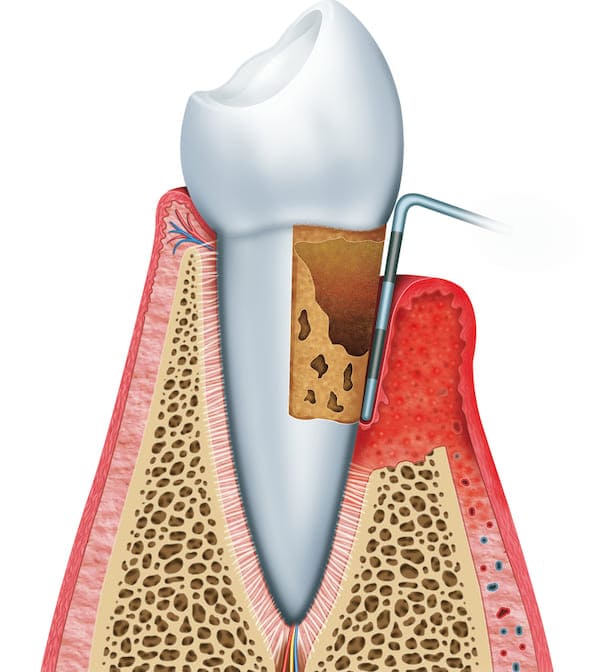
When bacteria destroy the tissue surrounding the tooth root, an empty space forms — the periodontal pocket. This pocket tends to deepen, progressing toward the root tip. As connective tissue is progressively destroyed, a point is reached where nothing holds the tooth in its socket. This leads first to tooth mobility, and eventually to tooth loss.

Contact us

How Is a Periodontal Pocket Treated?

Treatment depends on the condition of soft and hard tissues, pocket depth, oral hygiene, and the patient's medical history. The treatment plan is determined by periodontology specialist Dr. Marija Vuković Stevanov based on clinical examination and radiographic findings.

Therapy may be causal (non-surgical) or surgical (modified Widman flap procedure with bone substitute placement).

If significant bone resorption is present and pocket depth exceeds 6 mm after completed causal therapy without signs of inflammation, surgical treatment of periodontitis is indicated. If pocket depth is below 4 mm after causal therapy, surgical intervention is not necessary — however, regular follow-up appointments and ultrasonic scaling remain mandatory.

When a high degree of tissue inflammation is present, causal therapy must be completed first to control the inflammation. At the follow-up appointment, pocket depth is re-measured to determine whether further causal therapy or surgical intervention is required.

Surgical therapy with bone graft placement enables long-term preservation and stability of the tooth, provided the patient maintains adequate oral hygiene and attends regular check-ups.

Treatment of Shallow Periodontal Pockets (up to 3–4 mm)

Ultrasonic removal of soft and hard deposits (tartar) with tooth polishing is essential. Air polishing after the procedure is also recommended to make tooth surfaces smooth and resistant to plaque and calculus build-up.

Detailed patient education on maintaining excellent oral hygiene follows — including proper brushing technique and the use of a soft-bristle toothbrush.

Interdental hygiene should be maintained using an oral irrigator, dental floss, and interdental brushes.

As part of daily oral hygiene, proper gum massage with gels recommended by periodontologist Dr. Marija Vuković Stevanov is essential. Following deposit removal, a therapeutic chlorhexidine-based rinse is typically advised — concentration and usage instructions are determined by Dr. Marija Vuković Stevanov.

At the follow-up appointment 10–15 days later, the periodontologist determines the next steps and recommends appropriate mouth rinses.

The goal of therapy is to radically halt the progression of gum inflammation and further deepening of the periodontal pocket.

Treatment of shallow periodontal pockets
Curettage of medium periodontal pockets

Treatment of Medium Pockets (4–6 mm)

Following measurement of pocket depth by probing, causal therapy for periodontitis involves thorough debridement of the periodontal pocket using specialized curettes.

Under local anesthesia, the hard wall of the periodontal pocket is carefully and thoroughly debrided, with removal of subgingival calculus (plaque, tartar), granulation tissue, and bacteria.

Following mechanical debridement, the periodontologist prescribes medication, provides detailed oral hygiene instructions, and schedules a follow-up appointment for 7–10 days later.

At the follow-up, Dr. Marija Vuković Stevanov re-measures pocket depth, evaluates the degree of inflammation, and determines the continuation of treatment.

If inflammation has significantly reduced and pocket depth has decreased, the path to full resolution is more straightforward.

If inflammation persists, revision and additional debridement are required until the inflammation is completely eliminated and pocket depth is reduced to an acceptable level.

Treatment of Deep Periodontal Pockets (over 6 mm)

In cases of deep periodontal pockets where depth remains above 6 mm following completed causal therapy, surgical treatment is indicated — a modified Widman flap procedure with bone substitute placement. This procedure is successfully performed at Vuković Dental Practice by spec. dr. Marija Vuković Stevanov, a periodontologist with extensive clinical experience.

When pocket depth after causal therapy exceeds 6 mm, surgical intervention is necessary to remove all granulation tissue down to the level of the alveolar bone, thoroughly clean and irrigate the bone, and place a bone substitute.

At Vuković Dental Practice, the bone substitute used is exclusively Bio-Oss, by the renowned Swiss manufacturer Geistlich. Each patient receives a certificate of the material used.

This bone substitute physically fills the defect and replaces missing bone. Through the chemical process of bone regeneration, it stimulates the formation of new bone cells, which progressively integrate into the graft — resulting in complete fusion of natural and synthetic bone.

This process takes approximately 2 months from the time of surgical intervention (modified Widman flap procedure with Bio-Oss bone substitute placement).

Surgical treatment of deep periodontal pockets with Bio-Oss
Contact us

When Can the Tooth Be Saved?

If there is no tooth mobility, or only minimal mobility remains following therapy, and tissue shows no signs of inflammation after pocket debridement or surgical treatment, the prognosis for tooth preservation is very good.

In cases of grade one mobility caused by tissue inflammation, successful therapy typically results in tooth stabilization and a favorable long-term prognosis.

Based on radiographic findings and clinical examination, spec. dr. Marija Vuković Stevanov will provide a precise prognosis for the tooth.

Whether the tooth can be saved depends on:

  the amount of remaining bone
  the depth of the periodontal pocket
  the degree of tooth mobility
  the patient's commitment to treatment and home care

Early recognition and timely treatment are the key to saving teeth. During and after therapy, maintaining an excellent level of oral hygiene and attending regular follow-up appointments with the periodontologist are essential to treatment success and long-term tooth preservation.

Contact us
Tooth preservation after periodontal pocket treatment

When Should You See a Periodontologist?

As soon as you notice the first signs of gum inflammation, such as:

  redness of the gums
  bleeding
  pain when chewing or gum recession

If you experience any of the following symptoms — bleeding gums, gum recession, bad breath, tooth mobility, food trapping between teeth, or pain when chewing — it is important that you contact periodontologist Dr. Marija Vuković Stevanov as soon as possible and schedule your periodontal examination.

Why Treat a Periodontal Pocket at Vuković Dental Practice?

All periodontal therapy is performed exclusively by Dr. Marija Vuković Stevanov, specialist in Periodontology and Oral Medicine.

Each patient receives a specialist examination, during which — following clinical assessment and radiographic analysis — a comprehensive treatment plan is presented in full detail: clinical, timeline, and financial.

Every patient is approached individually, and the treatment plan proposed by spec. dr. Marija Vuković Stevanov is based exclusively on that patient's specific situation.

The individualized treatment plan includes regular follow-up appointments and continuous monitoring throughout the complete and complex therapeutic process.

At Vuković Dental Practice, spec. dr. Marija Vuković Stevanov is responsible for long-term patient follow-up, regular check-ups, and maintenance of results achieved through successful therapy.

Frequently Asked Questions

1. Can a periodontal pocket be treated simply by brushing?

Unfortunately, no. Once a periodontal pocket has formed, it becomes inaccessible to a toothbrush or dental floss. A brush can effectively clean to a depth of about 2–3 mm, but anything beyond that requires professional cleaning to remove the calculus that "feeds" the pocket. As spec. dr. Marija Vuković Stevanov explains, without removing deposits below the gum line, the infection cannot be stopped by home hygiene alone — no matter how thorough.

2. Is pocket curettage painful?

At Vuković Dental Practice, curettage is performed under local anesthesia, making the procedure completely painless. The patient feels only slight pressure during the treatment. Temporary sensitivity to hot and cold may occur afterward, but this typically resolves within a day or two. Spec. dr. Marija Vuković Stevanov always tailors the approach to each patient's individual sensitivity to ensure the most comfortable experience possible.


3. How long is the recovery after surgical pocket treatment?

Following a flap procedure, sutures are typically removed after 7 to 10 days. Most patients return to their daily activities the following day, provided they follow the dietary and oral hygiene guidelines. Recovery is generally quick and uncomplicated, particularly when patients follow the recommendations given by periodontology specialist dr. Marija Vuković Stevanov at postoperative check-ups.

4. Can the pocket return after treatment?

Periodontal disease is a chronic condition that requires long-term management. Treatment closes the pocket and stops the infection, but without regular check-ups every 3–6 months and good oral hygiene, bacteria can accumulate again. Consistent maintenance of gum health is essential for lasting results and tooth preservation.

5. Does pocket curettage damage the gums?

On the contrary — curettage helps the gums recover and become firm and healthy again. By removing infected and inflamed tissue, conditions are created for healthy tissue to reattach to the tooth. This reduces swelling, redness, and bleeding. In the experience of periodontology specialist dr. Marija Vuković Stevanov, patients often notice a visible improvement in the appearance and health of their gums within just a few weeks.

Periodontal Pocket Treatment in Belgrade – Vuković Dental Practice, Voždovac


Česta pitanja

1. Da li se parodontalni džep može izlečiti samo pranjem zuba?

Nažalost, ne. Kada se parodontalni džep jednom formira, on postaje nedostupan za vlakna četkice i zubni konac. Četkica može efikasno očistiti do 2–3 mm dubine, ali sve preko toga zahteva profesionalno čišćenje kod stomatologa kako bi se uklonio kamenac koji „hrani“ džep. Kako objašnjava spec. dr Marija Vuković Stevanov, bez uklanjanja naslaga ispod nivoa desni, infekcija se ne može zaustaviti kućnom higijenom, ma koliko ona bila temeljna.

2. Da li je kiretaža džepova bolna?

U Ordinaciji Vuković, kiretaža se izvodi pod lokalnom anestezijom, tako da je postupak za pacijenta potpuno bezbolan. Tokom intervencije pacijent ne oseća bol, već samo blagi pritisak. Nakon zahvata može se javiti prolazna osetljivost na toplo i hladno, koja najčešće nestaje u roku od dan ili dva. Spec. dr Marija Vuković Stevanov uvek prilagođava pristup individualnoj osetljivosti pacijenta, kako bi tretman bio što prijatniji

3. Koliko dugo traje oporavak nakon hirurškog lečenja džepa?

Ukoliko se radi režanj operacija, konci se obično skidaju nakon 7 do 10 dana. Većina pacijenata se vraća svakodnevnim aktivnostima već narednog dana, uz poštovanje saveta o ishrani i oralnoj higijeni. Oporavak je uglavnom brz i bez komplikacija, naročito ako se pacijent pridržava preporuka koje daje specijalista parodontologije dr Marija Vuković Stevanov tokom postoperativnih kontrola.

4. Da li se džep može ponovo vratiti nakon izlečenja?

Parodontopatija je hronična bolest, što znači da zahteva dugoročnu kontrolu. Lečenjem se parodontalni džep „zatvara“ i infekcija se zaustavlja, ali bez redovnih kontrola na 3–6 meseci i dobre oralne higijene, bakterije se mogu ponovo nagomilati. Kontinuitet u održavanju zdravlja desni ključan je za dugotrajan rezultat i očuvanje zuba.

5. Da li kiretaža džepa oštećuje desni?

Naprotiv, kiretaža pomaže desnima da se oporave i ponovo postanu čvrste i ružičaste. Uklanjanjem inficiranog i zapaljenog tkiva, stvara se uslov da se zdravo tkivo ponovo „priljubi“ uz zub. Time se smanjuju otok, crvenilo i krvarenje desni. Prema iskustvu specijaliste paronotologije dr Marije Vuković Stevanov, pacijenti često već nakon nekoliko nedelja primećuju vidljivo poboljšanje izgleda i zdravlja desni.

poziv
V
Book a consultation